Amazon Kindle, UK


Showing posts with label GLBT. Show all posts

Friday, 24 January 2014

Henri Nouwen, Catholic Priest

b. January 24, 1932
d. September 21, 1996

Over the years, I have come to realize that the greatest trap in our life is not success, popularity, or power, but self-rejection. Success, popularity, and power can indeed present a great temptation, but their seductive quality often comes from the way they are part of the much larger temptation to self-rejection. When we have come to believe in the voices that call us worthless and unlovable, then success, popularity, and power are easily perceived as attractive solutions. The real trap, however, is self-rejection.
A Dutch-born Catholic priest and writer who authored 40 books about spirituality. Nouwen's books, which are still being read today, include The Wounded Healer, In the Name of Jesus, Clowning in Rome, Life of the Belovedand The Way of the Heart.. The results of a Christian Century magazine survey conducted in 2003 indicate that Nouwen's work was a first choice of authors for Catholic and mainline Protestant clergy.One of his most famous works is Inner Voice of Love, his diary from December 1987 to June 1988 during one of his most serious bouts with clinical depression - which was rooted in part, in his early conflicts over sexuality and celibacy.


Nouwen is thought to have struggled with his sexuality. "Although his homosexuality was known by those close to him, he never publicly claimed a homosexual identity." Although he never directly addressed the matter of his sexuality in the writings he published during his lifetime, it is said that he acknowledged the struggle both in his private journals and in discussions with friends, both of which were extensively referenced by Michael Ford in the biography Wounded Prophet, which was published after Nouwen's death. Ford suggests that Nouwen only became fully comfortable with his sexual orientation in the last few years of his life, and that Nouwen's depression was caused in part by the conflict between his priestly vows of celibacy and the sense of loneliness and longing for intimacy that he experienced. Ford conjectured, "This took an enormous emotional, spiritual and physical toll on his life and may have contributed to his early death." There is no evidence that Nouwen ever broke his vow of celibacy

His spirituality was influenced notably by his friendship with Jean Vanier. At the invitation of Vanier, Nouwen visited L'Arche in France, the first of over 130 communities around the world where people with developmental disabilities live with those who care for them. In 1986 Nouwen accepted the position of pastor for a L'Arche community called "Daybreak" in Canada, near Toronto. Nouwen wrote about his relationship with Adam, a core member at L'Arche Daybreak with profound developmental disabilities, in a book titled Adam: God's Beloved. Father Nouwen was a good friend of the late Cardinal Joseph Bernardin.


Books:


Ford, Michael: Wounded Prophet: A Portrait of Henri J.M. Nouwen


The Wounded Healer: Ministry in Contemporary Society
In the Name of Jesus: Reflections on Christian Leadership
Clowning in Rome: Reflections on Solitude, Celibacy, Prayer, and Contemplation
Life of the Beloved: Spiritual Living in a Secular World
The Way of the Heart
Enhanced by Zemanta

Saturday, 5 January 2013

Alvin Ailey Jr.

b. January 5, 1931
d. December 1, 1989

“I am trying to show the world that we are all human beings and that color is not important. What is important is the quality of our work.”


A prolific choreographer, Alvin Ailey created 79 original works for his company. His signature piece, “Revelations” (1960), is touted as the most-watched work of modern dance.


Alvin Ailey Jr. was an internationally acclaimed dancer and choreographer. He founded the Alvin Ailey American Dance Theater, a dance company hailed as an ambassador of American culture. Ailey formed a multiracial company and revolutionized dance, incorporating elements of ballet and jazz, along with modern and African dance, into his work.
Ailey grew up in Rogers, Texas, the son of a young, struggling single mother. His father abandoned the family when Ailey was six months old. In 1941, the family moved to Los Angeles, where Ailey met Lester Horton, who ran the first multiracial dance school.
Horton took Ailey under his wing, teaching him a variety of dance styles and techniques. In 1953, Ailey joined Horton’s company. Later that year, he was named artistic director.
In 1954, Ailey made his Broadway debut dancing in “House of Flowers.” He also performed in “Sing, Man, Sing” with Harry Belafonte and in “Jamaica” with Lena Horne.
In 1957, Ailey established the Alvin Ailey American Dance Theater. The company’s premiere performance, “Blues Suite”—a riveting work reflecting the African- American emotional experience—defined Ailey’s theatrical and eclectic style.
A prolific choreographer, Ailey created 79 original works for his company. “Revelations” (1960), recognized as his signature piece, is touted as the most-watched work of modern dance. “Cry” (1971), one of Ailey’s most successful works, was dedicated to his mother and African-American women.
In 1979, Ailey received the Springarn Medal for outstanding achievement from the NAACP. In 1988, he was recognized with a Kennedy Center Honors Award.
Ailey died at age 58 from complications of AIDS. In his memory, a section of West 61st Street in New York was named “Alvin Ailey Way.”


Enhanced by Zemanta

Saturday, 22 December 2012

Jean-Michel Basquiat, painter

b. December 22, 1960
d. August 12, 1988


Basquiat was a graffiti artist whose painting became a major force in revitalizing American art in the late 20th century.


Basquiat grew up in a middle class environment in Brooklyn. His father, an accountant, was Haitian and his mother was Puerto Rican. As a teenager, he left home to live in lower Manhattan, selling hand-painted t-shirts and postcards on the street. His work began to attract attention around 1980 after a group of underground artists held a public exhibition, the Times Square Show.
Basquiat's unique visual lexicon compounded of "graffiti symbols and urban rage" (Publishers Weekly) challenged accepted notions of art. His vivid paintings incorporated such diverse images as African masks, quotes from Leonardo andGray's Anatomy, Egyptian murals, pop culture, and jazz. His personal visual vocabulary included three-pronged crowns and the c symbol. Critics called his work "childlike and menacing" and "neo-primitive."
Basquiat associated with other "Neo-Expressionist" artists whose work drew from popular culture, including Andy Warhol, Julian Schnabel, and Keith Haring. Haring said of Basquiat's early work: "The stuff I saw on the walls was more poetry than graffiti. They were sort of philosophical poems . . . . On the surface they seemed really simple, but the minute I saw them I knew that they were more than that. From the beginning he was my favorite artist."
Embraced by the art world, Basquiat soared to international fame. In 1982 his work was exhibited in New York, Los Angeles, Rome, Rotterdam and Zurich, and he was the youngest artist ever to be included in the prestigious German exhibition, Documenta 7. In 1985 he appeared on the cover of The New York Times Magazine.
The artist's close friends became increasingly concerned about his drug use and erratic behavior. Jean-Michel Basquiat died at the age of 27 of a heroin overdose.
Bibliography:
Enhanced by Zemanta

Monday, 26 November 2012

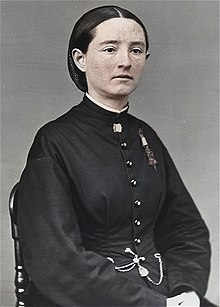
Mary Edwards Walker, Surgeon

b. November 26, 1832
d. February 21, 1919


A steadfast feminist, Mary Edwards Walker defied nineteenth century patriarchal society by refusing to live within the confines of gender-based roles. As a student, physician, and activist, Walker defined her place in society while paving the way for future generations of women. Diverging from the norm, Walker's liberal parents encouraged her and her five sisters to attend college and pursue careers. Her father, a self-taught doctor and advocate of women's dress reform, largely influenced Walker.

In 1855, Mary Edwards Walker graduated from Syracuse Medical College, becoming one of only a few female physicians in the country. She married fellow student and physician Albert Miller in an unconventional ceremony. Walker wore trousers and a man's coat and chose to keep her last name. The marriage ended four years later.

At the onset of the Civil War, having been denied a position as an Army medical officer, Walker volunteered as a nurse for the Union Army. During the next few years she served in several battles including the First Battle of Bull Run and the Battle of Fredericksburg. Despite her service, Walker often found herself at the scrutiny of male superiors who questioned her credentials.

The Confederate Army captured Walker in 1864 and held her captive for four months. The imprisonment proved to be a turning point in her career, winning her both respect and credibility. Later that year she became the first woman commissioned as Army Surgeon, earning a monthly salary of one hundred dollars.
The following year, Walker became the first and only woman in history to receive a Medal of Honor, the highest military honor in the United States. The bill, which President Andrew Johnson signed upon the recommendation of two major generals, reads:

Whereas it appears from official reports that Dr. Mary E. Walker, a graduate of medicine, has rendered valuable service to the Government, and.has devoted herself with much patriotic zeal to the sick and wounded soldiers, both in the field and hospitals, to the detriment of her own health, and has also endured hardships as a prisoner of war four months in Southern prison while acting as contract surgeon...It is ordered, That a testimonial thereof shall be hereby made and given to the said Dr. Mary E. Walker, and that the actual medal of honor for meritorious services be given her.

After the war, Walker continued to live a nonconformist lifestyle. A strong advocate of dress reform, she wore men's clothing exclusively and was arrested on several occasions for impersonating a man. In 1917, Congress revoked her Medal of Honor after revising the criteria for receiving the medal. Walker refused to return the medal, wearing it until her death.

Monday, 12 November 2012

Cardinal Francesco Maria de' Medici, Gay Cardinal?

b. 12 November 1660
d. 3 February 1711


Born in Florence, the son of Grand duke Ferdinando II of Tuscany and Vittoria Della Rovere. In 1683 he was appointed to governor of Siena, a position he maintained until his death. He was the grand prior of the Sovereign Order of Malta in Pisa. Abbot commendatario of S. Galgano, Siena. Abbot commendatario of S. Stefano, Carrara, 1675. According to a family tradition was promoted to the cardinalate at a young age in 1686. He remained in Florence, in his villa of Lappeggi, devoting himself to a life not really religious, made of amusements and love affairs with men. He resigned cardinalate on June 19, 1709 and was named prince of Siena. He then was forced to marry in 1709 Eleonore Luisa Gonzaga, duchess of Guastalla, daughter of Vincenzo Gonzaga, in an attempt to save the dynasty, but they did not have children.

Enhanced by Zemanta

Monday, 15 October 2012

Michel Foucault

Philosopher
b. October 15, 1926
d. June 25, 1984
“It’s not enough to affirm that we are gay, but we must also create a gay life.”


Michel Foucault was a French philosopher, sociologist and educator who had a profound impact on academic thought. Foucault is best known for his critical studies of psychiatry, the prison system and human sexuality.
Foucault was born Paul-Michel Foucault in Poitiers, France, the son of a prominent surgeon. He graduated from the prestigious École Normale Supérieure, where he earned degrees in psychology and philosophy. Studying philosophy with the distinguished Maurice Merleau-Ponty, Foucault was recognized as a brilliant emerging academic.
In 1960, Foucault became head of the philosophy department at the University of Clermont-Ferrard, where he wrote his groundbreaking book, “Madness and Civilization” (1961). Foucault earned his doctorate and met philosophy student Daniel Defert, who became his lover for 20 years.
When Defert was deployed for military service in Tunisia, Foucault followed, and in 1965, took a teaching position at the University of Tunis. Foucault’s second major work “The Order of Things” (1966) was a best seller in France and established him as an esteemed intellectual.
In 1970, Foucault was elected Professor of the History of Systems of Thought at the Collège de France, the nation’s preeminent academic institution. He published “Discipline and Punish: The Birth of the Prison” (1975), his most influential book. Foucault founded the Prisoner Information Group to give inmates a forum to share their concerns.
In the mid-1970’s, Foucault taught at the University of California, Berkeley. He became enamored with San Francisco and its liberated gay sexuality—especially the bathhouses. “I think that it is politically important that sexuality be able to function … as in the bathhouses,” he wrote. “You cease to be imprisoned in your own face, your own past, in your own identity.”
Foucault worked on “The History of Sexuality,” a planned six-volume project. He  completed three volumes, which were published shortly before his death. The first volume had a powerful influence on gay consciousness.
In 1984, Foucault died of complications from AIDS at age 58, leaving a legacy of important works affecting contemporary issues of GLBT identity.
Bibliography


Books about Michel Foucault


Books by Michel Foucault


Videos


Websites


Enhanced by Zemanta

Wednesday, 5 September 2012

John Cage

b. September 5, 1912
d. August 12, 1992


“I can’t understand why people are frightened of new ideas. I’m frightened of the old ones.”

 
A fascination with Taoism I’m frightened of the old ones.” and Zen Buddhism led John Cage to chance music. Based on the “I Ching”— the Zen book of changes— and the flip of a coin, he created compositions solely by chance
Twentieth century composer John Cage pushed the boundaries of traditional music, experimenting with sound, environment and audience perception. His avant-garde work influenced music, painting, dance, performance art and poetry.
Cage was born in Los Angeles. He was playing piano on the radio regularly by the time he was 12. The son of an inventor, Cage developed a reputation for innovation and originality—qualities that became the hallmarks of his career.
In 1930, after two years at Pomona College, Cage left for a less traditional education in Europe. Settling in Paris, he spent 18 months painting, writing poetry and composing music, before returning to California to focus on music.
From 1931 to 1936, Cage’s composition teachers included Adolph Weiss, Henry Cowell and Arnold Schoenberg. Schoenberg declared the young man “not a composer, but an inventor of genius.”
In 1937, Cage worked as a dance accompanist in Seattle, where he met dancer and choreographer Merce Cunningham. The two became professional and life partners for the next 50 years.
In 1938, Cage began to experiment. He composed pieces for the prepared piano—a piano he created with objects placed on and between the strings to alter sound. He also used record players and phonographs as instruments.
In the 1940’s, Cage continued to pursue unorthodox techniques. His fascination with Taoism and Zen Buddhism led him to chance music. Based on the “I Ching”—the Zen book of changes—and the flip of a coin, Cage created compositions solely by chance.
In 1948, Cage joined the Black Mountain College faculty and began collaborating with David Tudor and Robert Rauschenberg, among others. He composed his most controversial piece “4’33’,” three scores of silence over 4 minutes and 33 seconds. The intended “music” of the piece is the unintentional sound created by the audience and the environment.
Cage continued to compose and collaborate with other artists. In his later years, he focused on electronic music, often using radios and “Happenings,” as he called them—pieces that are mostly unwritten, except for timed intervals in which a note, a sound or silence is scheduled.
John Cage was also a writer, philosopher, visual and performance artist, and cofounder of the New York Mycological Society for the study, collection and appreciation o www.glbtHistoryMonth.com f mushrooms and fungi.

Bibliography


Books About John Cage


Books By John Cage


Music & Performances by John Cage


Other Resources


Enhanced by Zemanta

Monday, 27 February 2012

"Eminent Outlaws: The GayWriters Who Changed America"

Book Review, at the Star Tribune:


Once World War II was over, there was no stopping gay writers from stepping out of the shadows.
It is remarkable to recall, as Christopher Bram does in "Eminent Outlaws," that 1948 saw publication of two overtly gay novels -- Gore Vidal's "The City and the Pillar" and Truman Capote's "Other Voices, Other Rooms." Capote's novel was "dazzling," said the Chicago Tribune, but Time magazine said his "theme is calculated to make the flesh crawl." Both books were bestsellers.
Bram, best known as a novelist ("Gods and Monsters"), gives an endlessly fascinating, first-of-its-kind account of about a dozen gay novelists, poets and playwrights, from Vidal and Tennessee Williams to Tony Kushner and Edmund White, each of whom had far-reaching impact over five postwar decades.
Even for those familiar with these writers, Bram's book serves an invaluable, connect-the-dots function. It's also an amiable, opinionated and occasionally gossipy guide to famous feuds, love affairs and literary treasures worth rediscovering.
-full review at StarTribune.com 

In an interview with the Strib, Christopher Bram named his personal favourites by some of the authors discussed in Eminent Outlaws: 
  • Edward Albee: "Who's Afraid of Virginia Woolf?"Hands down.
  • James Baldwin: "Another Country." In a way this is a post-gay novel. It has gay and straight characters and a sex scene between a gay man and a straight man. It's the mid-'60s and he's already writing a post-gay novel.
  • Christopher Isherwood: "Down There on A Visit." I love "A Single Man," but "Down There on a Visit" is even better. I love its scope.
  • Edmund White: "A Farewell Symphony." It has a wimpy last quarter, but it has great stuff before then.
  • Tennessee Williams: "A Streetcar Named Desire." The great American play, with a major gay episode in it.
  • Armistead Maupin: "The Night Listener"
  • Andrew Holleran: "Dancer from the Dance." It really holds up. It's now become a great historical novel of New York in the '70s.

Tuesday, 24 January 2012

24 January: Frederick II, Prussian King 1740 - 1786

b. January 24, 1712
d. August 17, 1786


The greatest and noblest pleasure which men can have in this world is to discover new truths; and the next is to shake off old prejudices.


Frederick II, also known as Frederick the Great, ruled as King of Prussia from 1740-1786. Through innovative military tactics and tolerant domestic policies, King Frederick united previously disconnected territories on opposite ends of the Holy Roman Empire into a cohesive kingdom with Prussia.

Frederick's predecessor, his father, presided over both his kingdom and his family without compassion. In 1730, when Frederick was 18 years old, he planned a getaway to England with Lieutenant Katte. Before the two men could depart, they were arrested and condemned to death for desertion. Frederick I had Katte executed in his son's presence. Frederick II escaped death and was sentenced to prison.
Frederick II received a royal pardon six months into his sentence. He ascended to the throne in 1739. He immediately began expanding Prussia's territory during the War of the Austrian Succession (1740-1748). During the first stage of this war, the First Silesian War (1740-1742), Frederick II captured the rich Austrian city of Silesia.

Regarded as one of the greatest tactical geniuses of all time, Frederick II used advanced techniques such as the oblique order to overwhelm foes who outnumbered Prussian forces. During his reign, Austria, France, Russia, Saxony and Sweden were allied against him as part of the Diplomatic Revolution. Frederick the Great's invasion of Saxony in 1756 initiated the Seven Years' War. Though allied with only Great Britain and Hanover, Prussia prevailed when the anti-Prussian coalition collapsed in 1763. Frederick II's ability to retain Silesia during this battle solidified Prussia's status as a power.


In addition to his military successes, which included the annexation of part of Poland in 1772, Frederick II modernized much of Prussia and fostered economic and artistic growth in his kingdom. State revenues doubled as he simultaneously promoted philosophy and the arts. A musician, Frederick the Great played the transverse flute and composed 122 sonatas and four symphonies.


Disagreeing with Machiavelli's ruthless "ends justify the means" philosophy of rule, Frederick the Great ran his kingdom according to the more modern ethical code he laid out in the "Anti-Machiavel" (1739). Under his reign, Frederick II abolished torture and corporeal punishment and provided religious freedom.

Bibliography

Enhanced by Zemanta

Saturday, 27 August 2011

Tom Ford, Fashion Designer/Filmmaker

b. August 27, 1961
“All I’ve done my entire life is fulfil my destiny.”


Tom Ford is a prominent creative entrepreneur whose accomplishments—first in the fashion world and later in the film industry—have earned him worldwide acclaim.
Born in Austin, Texas, Ford grew up in Santa Fe, New Mexico. At 17, he moved to New York to study art history at New York University, but was smitten with fashion and design. He graduated with a degree in architecture from what is now Parsons The New School for Design.
His first foray into fashion was in Paris, where he interned for Chloe. He worked for American designer Cathy Hardwick next, before moving on to Perry Ellis.
Ford moved to Milan in 1990, where he served as Gucci’s head women’s designer. Two years later, he was named design director. In 1994, he became creative director of Gucci's Italian label. Ford is credited with turning around the historic fashion house in his short time at the company. In 2000, he was granted new responsibilities at sister label Yves Saint Laurent, where he served as the creative director for YSL Rive Gauche and YSL Beaute.
In 2005, Ford left Gucci and formed his own fashion brand, TOM FORD. Two years later, his flagship store opened in New York. By the summer of 2010, TOM FORD had opened 20 more stores worldwide. In addition to his remarkable financial success, Ford has won many prestigious awards, including five from the Council of Fashion Designers of America.
Ford’s lifetime ambition, however, was to make a film. He says, “I guess I’m just one of these people who when I decide I’m going to do something, I just do it.” In 2009, he wrote, produced, financed and directed “A Single Man,” an adaptation of Christopher Isherwood’s 1964 novel. The movie centers on a gay man’s mourning over his partner’s tragic death. The film premiered at the Venice Film Festival and was nominated for numerous awards, including a Best Actor Academy Award nomination for Colin Firth.
Ford lives with his partner of more than 20 years, journalist Richard Buckley, in their London, Santa Fe and Los Angeles homes.
Enhanced by Zemanta

Monday, 20 June 2011

E. Lynn Harris, African-American Novelist

Author    
b. June 20, 1955
d. July 23, 2009
“I want people to know they don’t have to live their lives in a permanent ‘Don’t Ask, Don’t Tell’ existence. Truth is a powerful tool.”


E. Lynn Harris is one of the nation’s most popular authors. Considered a literary pioneer, Harris introduced millions of readers to characters rarely seen in literature—black gay men who are affluent, complex and sometimes troubled. With 10 consecutive New York Times best sellers, he remains one of the most successful African-American novelists.

Harris was born Everette Lynn Jeter in Flint, Michigan, to unmarried parents. At age 3, Everette moved with his mother to Little Rock, Arkansas. Everette's surname was changed to Harris after his mother married Ben Harris. When Everette was 13, his mother divorced his stepfather, who had abused the boy for years.

Harris attended the University of Arkansas. In 1977, he graduated cum laude with a Bachelor of Arts in Journalism. Harris was the school’s first black cheerleader.

After graduation, Harris worked as a sales executive for IBM, eventually settling in Atlanta. He remained in the closet for many years, which led to depression, heavy drinking and a suicide attempt in 1990. Writing helped him find the will to live.

His first novel, “Invisible Life” (1991), was self-published and quickly rose to the top of the Blackboard Bestseller List of African-American titles. Harris sold the books door-to-door from the trunk of his car to local beauty salons and bookstores. After the success of his first book, Doubleday signed Harris and became his long-term publishing company.

" 'Invisible Life' had to be the first book out of me,” Harris said. “It helped me deal with my own sexuality.”
Harris wrote more than a dozen novels and paved the way for the next generation of African-American novelists. His books are accessible to the masses and appeal to a diverse audience. Harris always made time for his fans, whom he said changed his life. He would answer up to 200 e-mails from readers every day.

Harris received numerous awards. His honors include three Blackboard Novel of the Year Awards, the James Baldwin Award for Literacy Excellence and three nominations for NAACP Image Awards.

Harris died from heart disease. “People loved him,” said Tina McElroy Ansa, a fellow author and friend. “A spirit of joy followed him through his life.”


Bibliography


Books by E. Lynn Harris


Article by E. Lynn Harris


Article about E. Lynn Harris


Website


Enhanced by Zemanta

Tuesday, 31 May 2011

Rainer Fassbinder, Film Director

b. May 31, 1945
d. June 10, 1982


“I’d like to be for cinema what Shakespeare was for theatre, Marx for politics and Freud for psychology: someone after whom nothing is as it used to be.”


Actor, director and screenwriter Rainer Fassbinder made over 40 films in his 15-year career.  He is among the most important figures in New German Cinema.
Born in the small Bavarian town of Bad Wörishofen, Fassbinder was raised by his mother. Her long hours at work left Fassbinder to occupy himself, which he did by going to the cinema. “The cinema was the family life I never had at home,” he said.
Leaving school before taking his final exams, Fassbinder immersed himself in film.  He made his first short films at age 20, persuading an older lover to finance and act in them.
In 1967, Fassbinder joined a radical theater troupe in Munich. He directed and acted in productions with Peer Raben, Kurt Raab, Hanna Schygulla and Irm Hermann, who became regulars in Fassbinder productions. The next year, Fassbinder directed “Katzelmacher,” his first play.
Fassbinder’s most prolific years as a director, writer and actor in film, theater, television and radio began in 1969. On average, he released one film every hundred days. 
A major theme of his work focuses on the individual’s tragic longing for love. Among his popular films are “Love Is Colder Than Death” (1969), “Ali: Fear Eats the Soul” (1973) and “I Only Want You to Love Me” (1976).  Often considered his best work, “Berlin Alexanderplatz” (1980) was a 15-hour television drama.
Several Fassbinder films deal with homosexuality, a taboo subject for major directors of the time. Films such as “Querelle” (1982) and “The Bitter Tears of Petra von Kant” (1971) focus on gays and lesbians as societal outsiders.
Fassbinder’s radical behavior, drug and alcohol addiction, frequent public appearances in the New York City leather scene, and violent relationships with lovers, both male and female, were followed in tabloids and gossip columns.
At age 37, Fassbinder died from an overdose of drugs and alcohol. His death marked the end of New German Cinema.

Bibliography


Video Interviews


Books By Rainer Fassbinder


Enhanced by Zemanta

Sunday, 29 May 2011

John Amaechi, Professional basketball player

b. May 29, 1947
Professional basketball player
“I am gay, black, British …
and I am now asserting my activism.”


“It was absolutely my ultimate goal to play in the NBA,” says Amaechi. In 1995, his dream became reality.

John Amaechi is the first NBA player to speak publicly about being gay. In 2007, three years after retiring from pro basketball, he became one of only six male professional athletes in the four major U.S. sports to come out.
Esera Tuaolo, an NFL player who came out in 2002, said of Amaechi, “What John did is amazing. He does not know how many lives he’s saved by speaking the truth.”
Amaechi, the son of a Nigerian father and a white British mother, grew up in England. When he started playing basketball at 16, his right hand was nearly severed in an accident. As a result, Amaechi became ambidextrous, which helped him become a better basketball player. Amaechi played basketball at Penn State University, where he was twice selected a First Team Academic All-American.
“It was absolutely my ultimate goal to play in the NBA,” says Amaechi. In 1995, Amaechi’s dream became reality. He played for the Cleveland Cavaliers, followed by the Orlando Magic and the Utah Jazz. In 2000, Amaechi made headlines when he turned down a $17 million offer from the Los Angeles Lakers. Opting to stay in Orlando earning $600,000 a year, Amaechi remained loyal to the Magic, who hired him when no other team would.
Amaechi’s memoir, “Man in the Middle” (2007), explores the challenges he faced as a closeted professional athlete.
After the NBA, Amaechi returned to Britain, where he turned to television sportscasting and covered the 2008 Beijing Olympics for the BBC. In Beijing, Amaechi also served as a human rights ambassador for Amnesty International. He appeared on several episodes of “Shirts & Skins,” a Logo reality series, where he mentored a gay basketball team and shared his experiences as an out athlete.
Amaechi owns Amaechi Performance Systems. He is a psychologist with a management consulting company specializing in workplace diversity and workplace climate and culture challenges.
Amaechi established the ABC Foundation, which builds sports centers in Britain and encourages children’s involvement in sports and their communities.
Enhanced by Zemanta

Monday, 9 May 2011

Kiyoshi Kuromiya , Author/AIDS Activist

"I really believe that activism is therapeutic."

b. May 9, 1943
d.
May 10, 2000

Kiyoshi Kuromiya was a Gay Pioneer and an early HIV/AIDS expert.

May 9: Kiyoshi Kuromiya , Author/AIDS Activist

"I really believe that activism is therapeutic."

b. May 9, 1943
d.
May 10, 2000

Kiyoshi Kuromiya was a Gay Pioneer and an early HIV/AIDS expert.