Amazon Kindle, UK


Showing posts with label Gay Lesbian and Bisexual. Show all posts

Monday, 3 February 2014

Gertrude Stein

Author
b. February 3, 1874
d.
July 27, 1946


A writer should write with his eyes and a painter paint with his ears
Gertrude Stein, portrait by Picasso
Known as an influential American writer who focused on character depth, Gertrude Stein spent most of her life in Paris. While in France she met her life partner, befriended famous artists and developed into an influential literary figure and feminist.
Born into a wealthy family in Pennsylvania, Gertrude Stein grew up in Oakland, California. As an undergraduate she attended Radcliffe College, now incorporated into Harvard University, and studied under psychologist William James. She spent much of 1899-1901 at Johns Hopkins University Medical School but did not earn her degree.
Stein moved to Paris in 1902 and became an avid art collector. She turned her house into an informal salon. It soon became a hotspot for famous artists and writers - including Pablo Picasso, Ernest Hemingway, Ezra Pound, Henri Matisse and Thornton Wilder. Hemingway viewed Stein as his mentor and Picasso became her close friend. Stein later called Paris a city of "The Lost Generation."
In 1907, Stein met life partner Alice B. Toklas. Together during WWI, Toklas and Stein drove supplies to French hospitals. After the war, Stein received a medal for her contributions.
Stein wrote her first book, "Q.E.D.," in 1903, but did not publish a novel until "Three Lives" (1909), a work heavily influenced by former professor James and writer William Henry. Unique because of its similarity to the art form of cubism, Stein's writing delved into a literary area previously unexplored. "Tender Buttons," a short collection of feminist poems published in 1914, resembled Pablo Picasso's artwork, albeit in different form. In 1926, Stein explained the connection during lectures at the University of Oxford and Cambridge University. She published her lectures as a book, "Composition and Explanation" (1926).
In 1932, "The Autobiography of Alice B. Toklas," a book that told Stein's life story, excited the American public. It was her first bestseller. Composers adapted several of her works, including Virgil Thomson's "Four Saints in Three Acts" and "The Mother of Us All."
Complex and progressive, Stein's writing transformed American literature and contributed to the feminist movement. A monument on the upper terrace of Bryant Park in New York City honors her memory.

Bibliography
“An Interview with Gertrude Stein.” Writing.upenn.edu. July 3, 2007
Will, Barbara. Gertrude Stein: Modernism and the Problem of “Genius.” Edinburgh University Press, 2000
Williams, William Carlos. “The Work of Gertrude Stein.” Center for Book Culture. July 3, 2007


Selected Works
Blood on the Dining Room Floor (1948)
Brewsie and Willie (1946)
First Reader and Three Plays (1946)
Four in America (1947)
How to Write (1931)
Ida (1941)
Last Operas and Plays (1949)
Lectures in America (1935)
Lucy Church Amiably (1930)
Matisse, Picasso and Gertrude Stein (1933)
Narration (1935)
Paris France (1940)
Picasso (1938)
Portraits and Prayers (1934)
Selected Writings of Gertrude Stein (1946)
The Autobiography of Alice B. Toklas (1933)
The Geographical History of America or the Relation of Human Nature to Human Mind (1936)
The World is Round (1939)
Things As They Are (1950)
Three Lives and Tender Buttons (2003)
Wars I Have Seen (1944)
What are Masterpieces (1940)
Enhanced by Zemanta

Thursday, 21 February 2013

February 21: Barbara Jordan

b. February 21, 1936
d. January 17, 1996
Representative Barbara Jordan (D-Texas) was the first African-American woman elected to Congress from a southern state. She was known as an outstanding orator and Constitutional scholar.
"My faith in the Constitution is whole, it is complete, it is total. I am not going to sit here and be an idle spectator to the diminution, the subversion, the destruction of the Constitution."


Barbara Jordan came to national prominence during the Watergate Scandal in 1974 when, as a freshman member of the House Judiciary Committee, she made an eloquent speech on the Constitution which was nationally televised in prime time. Her speech set the stage for President Richard Nixon's resignation.
Journalist Molly Ivins said of Jordan, "It seemed to me that the words 'first and only' came before Barbara Jordan['s name] so often that they seemed like a permanent title: the first and only black woman to serve in the Texas State Senate, the first black woman elected to Congress, the first black elected to Congress [since] Reconstruction, the first black woman to serve on corporate boards. She broke so many barriers."
The daughter of a Baptist minister, Barbara Jordan grew up during the days of segregation in Houston's Fifth Ward. She earned degrees from Texas Southern University and Boston University Law School and was admitted to both the Massachusetts and Texas bars before becoming active in politics during the 1960 presidential campaign.
In 1976, Jordan delivered the keynote address at the Democratic National Convention, a speech many historians consider the best political keynote speech in modern history.
Jordan began to suffer the physical effects of multiple sclerosis in the 1970's. In 1979, she retired from politics to become a professor at the University of Texas at Austin. She addressed the Democratic National Convention in 1992.
In 1994, President Bill Clinton awarded Jordan the nation's highest civilian honor, the Presidential Medal of Freedom.
At Jordan's funeral in 1996, President Clinton eulogized her: "Whenever she stood to speak, she jolted the nation's attention with her artful and articulate defense of the Constitution, the American Dream, and the common heritage and destiny we share, whether we like it or not. "
Bibliography:
Selected works by Barbara Jordan:
Enhanced by Zemanta

Monday, 26 November 2012

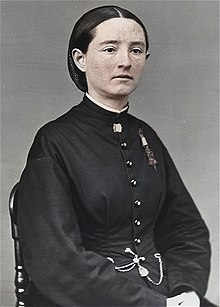
Mary Edwards Walker, Surgeon

b. November 26, 1832
d. February 21, 1919


A steadfast feminist, Mary Edwards Walker defied nineteenth century patriarchal society by refusing to live within the confines of gender-based roles. As a student, physician, and activist, Walker defined her place in society while paving the way for future generations of women. Diverging from the norm, Walker's liberal parents encouraged her and her five sisters to attend college and pursue careers. Her father, a self-taught doctor and advocate of women's dress reform, largely influenced Walker.

In 1855, Mary Edwards Walker graduated from Syracuse Medical College, becoming one of only a few female physicians in the country. She married fellow student and physician Albert Miller in an unconventional ceremony. Walker wore trousers and a man's coat and chose to keep her last name. The marriage ended four years later.

At the onset of the Civil War, having been denied a position as an Army medical officer, Walker volunteered as a nurse for the Union Army. During the next few years she served in several battles including the First Battle of Bull Run and the Battle of Fredericksburg. Despite her service, Walker often found herself at the scrutiny of male superiors who questioned her credentials.

The Confederate Army captured Walker in 1864 and held her captive for four months. The imprisonment proved to be a turning point in her career, winning her both respect and credibility. Later that year she became the first woman commissioned as Army Surgeon, earning a monthly salary of one hundred dollars.
The following year, Walker became the first and only woman in history to receive a Medal of Honor, the highest military honor in the United States. The bill, which President Andrew Johnson signed upon the recommendation of two major generals, reads:

Whereas it appears from official reports that Dr. Mary E. Walker, a graduate of medicine, has rendered valuable service to the Government, and.has devoted herself with much patriotic zeal to the sick and wounded soldiers, both in the field and hospitals, to the detriment of her own health, and has also endured hardships as a prisoner of war four months in Southern prison while acting as contract surgeon...It is ordered, That a testimonial thereof shall be hereby made and given to the said Dr. Mary E. Walker, and that the actual medal of honor for meritorious services be given her.

After the war, Walker continued to live a nonconformist lifestyle. A strong advocate of dress reform, she wore men's clothing exclusively and was arrested on several occasions for impersonating a man. In 1917, Congress revoked her Medal of Honor after revising the criteria for receiving the medal. Walker refused to return the medal, wearing it until her death.

Thursday, 22 November 2012

Benjamin Britten (1913 – 1976), UK. Composer.

b. 22 November 1913  
d.  4 December 1976


English composer, conductor, and pianist, has a firm reputation as possibly the greatest English composer of since Henry Purcell, and as one of the leading composers globally of the twentieth century. He is particularly important in the field of opera.  According to Operabase, he has more operas played worldwide than any other composer born in the 20th century, and only Puccini and Richard Strauss come ahead of him if the list is extended to all operas composed after 1900.

He first came to public attention with the a cappella choral work "A Boy Was Born" in 1934, and continued to produce important works for four decades. Having previously declined a knighthood, Britten accepted a life peerage in 1976 as Baron Britten, of Aldeburgh, a few months before his death.

He and his partner the tenor Sir Peter Pears, are one of the best known gay couples in music. Their two graves lie side by side in Aldeburgh.

In Paul Russell's book "The Gay 100: A Ranking of the Most Influential Gay Men and Lesbians, Past and Present", Britten in listed at number 73.


Enhanced by Zemanta

Sunday, 25 March 2012

Grand Prince Vasily III of Moscow (149 - 1533), Russian Prince

b. 25 March, 1479
d.  3  Dec, 1533 
r. 1505 to 1533


Grand Prince Vasily III(also spelled Basil) Ivanovich, Ivan III's son, came to the Russian throne in 1505, and greatly strengthened the monarchy, consolidatingd the numerous independent Russian principalities into a united Muscovite state by annexing Pskov (1510), Smolensk (1514) in a war with Sigismund I of Poland and Lithuania, Ryazan (1517), Starodub and Novgorod-Seversk by 1523.
Vasily was homosexual throughout his life. He went to the extent of announcing this fact to other gay men of his time by shaving off his beard when his twenty-year marriage to his first wife was terminated--being beardless was a sort of gay password at the time. 

During Vasily's second marriage, he was able to perform his conjugal duties only when an officer of his guard joined him and his wife in bed in the nude. 

After his death in 1533, he was succeeded by his better known son, Ivan III, who is also of queer interest, for his fondness for close male friends in female dress.  

Related Posts:


Enhanced by Zemanta

Thursday, 19 January 2012

January 19th in Queer History

Born this day

Patricia Highsmith (1921 – 1995) US
Author

Pat Patterson (1941 – ) Canadian
Wrestler

Stan Persky (1941 – ) Canadian 
Columnist / Author


Janis Joplin (1943 – 1970 ) US
Singer

Marshall Kirk McKusick (1954 –) US
Computer Programmer

Rob Cryston (1971 – ) US
Porn

Steve Balderson (1975 – ) US
Director

Natalie Cook ( 1975 – ) Australian 
Beach Volleyball

Coral Smith (1979 – ) US
Reality TV [Real World]

Luke MacFarlane (1980 – ) Canadian 
Actor

Leo Babsky (1982 – ) UK
Sculptor / Artist

Died this day

Max Adrian (1903 - 1973 ) UK
Actor / Singer

Morris Kight (1919 - 2003) US
Activist

K Sello Duiker (1974 - 2005 ) South African
Writer, whose debut novel, "Thirteen Cents", won the 2001 Commonwealth Writers Prize for best first book written by an African writer. He was a pioneer among Black South African writers in tackling the taboo subject of homosexuality, and male-to-male sexual violence.

Gary Downie  (1925 - 2006 ) UK
Production Manager

Sodomy in history, January 19th

1851 — The "State of Deseret," better known as Utah, enacts a criminal code that makes sodomy illegal only between males, and sets the penalty at a prison term and/or fine in the discretion of the court.

1887 — Newspapers report an apparent blackmail ring in Greenville, Ohio that leads to seven indictments and one conviction for sodomy, but the Governor of Ohio pardons the one convicted.

1897 — The Missouri Supreme Court upholds a conviction for assault to commit sodomy of a St. Louis police officer who attempted sodomy with another male after threatening to arrest him unless he accompanied him to a lumber yard, where the attempt was made.

1900 — An Ohio newspaper reports that a man was arrested for sex with his 13-year-old male companion. Both claim that the younger partner’s mother "gave" him to the other.

1949 — The Illinois Supreme Court overturns the contempt citation of a man convicted of consensual sex with another man for refusing to be interviewed by a psychiatrist under the state’s psychopathic offender law. The trial court held him in contempt, then tried and jailed him after he would not give in.

1995 — The Idaho Court of Appeals rules that the sodomy law can not be applied to married couples.

,
Sources:

Thursday, 1 September 2011

Leslie Feinberg, transgender activist and writer

Author/Activist
b. September 1, 1949
"Gender is the poetry each of us makes out of the language we are taught."


Leslie Feinberg is a leading transgender activist, speaker and writer. Feinberg is a national leader in the Workers World Party and a managing editor of Workers World newspaper.

Feinberg was born in Kansas City, Missouri, into a working-class family. In the 1960’s, she came of age in the gay bars of Buffalo, New York.

Now a surgically female-to-male transgender, Feinberg is an outspoken opponent of traditional Western concepts about how a “real man” or “real woman” should look and act. Feinberg supports the use of gender-neutral pronouns such as “ze” instead of he or she, and “hir” instead of him or her.

Feinberg is well-known for forging a strong bond between the lesbian, gay, bisexual and transgender communities, and other oppressed minorities. “Everyone who is under the gun of reaction and economic violence is a potential ally,” Feinberg says.

Friday, 10 June 2011

Sharon Farmer, White House Photographer

White House Photographer
b. June 10, 1951
“Never turn down a chance to show what you can do.”


Sharon Farmer was a White House photographer during both terms of the Clinton presidency. She was the first woman and first African-American to direct the office charged with chronicling nearly every second—from the mundane to the monumental—of the nation’s highest office.

Born in Washington, D.C., in 1951, Farmer was interested in photography from a young age. She discovered the power of the medium looking at pictures in her family’s encyclopedia. Farmer attended Ohio State University, intending to study bassoon. She quickly switched her major to photography and honed her skills on the staff of the yearbook.

The Associated Press hired Farmer for a photojournalism internship during her senior year. After graduation, she returned to her hometown of Washington, D.C., where she became a freelancer and photographer for album covers.

In 1993, she was hired as a White House photographer, a fast-paced job in which she used approximately 3,000 rolls of film per year and traveled the globe on a moment’s notice. In 1999, she was promoted to director of White House photography.

During her stint at the White House, Farmer captured many prominent events, including the handshake between Israeli Prime Minister Yitzhak Rabin and Palestinian leader Yasser Arafat, and the swearing in of Nelson Mandela as the president of South Africa.  

Farmer also chronicled many political races, from local to national. In 2004, she served as the head photographer for Senator John Kerry’s presidential campaign.

In addition to being featured in individual shows and group exhibitions nationwide, Farmer has lectured for
National Geographic and the Smithsonian Institution and has taught at American University. She resides in Washington, D.C.


Bibliography

  • Anand, Vineeta. "Former White House Photographer Describes ‘Helluva Ride.’" National Press Club. 1 May 2009.
  • "Behind the lens to center focus: First African American Female Photographer in the White House visits N.C. State.” The Nubian Message. 7 February 2009.
  • Gillis, Casey. "Shooting history: Former White House photographer to exhibit in Lynchburg."Lynchburg News Advance. 5 September 2009.
  • "Inside the White House." The White House. 24 May 2010.
  • "Sharon Farmer." The History Makers. 24 May 2010.

Published Work by Sharon Farmer


Websites


Enhanced by Zemanta