Amazon Kindle, UK


Showing posts with label Homosexuality. Show all posts

Tuesday, 6 November 2012

Pyotr Ilyich Tchaikovsky, Composer

b. May 7, 1840
d.
November 6, 1893

"Music’s triumphant power lies in the fact that it reveals to us beauties we find in no other sphere."
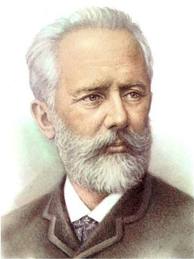
Pyotr Ilyich Tchaikovsky is one of the most popular composers in history. His best-known works include the ballets "Swan Lake," "The Sleeping Beauty," and "The Nutcracker";  the operas "The Queen of Spades" and "Eugene Onegin"; and the widely recognized Fantasy Overture “Romeo and Juliet" and "1812 Overture."
Tchaikovsky was born in Votinsk, Russia, a small industrial town. His father was a mine inspector. His mother, who was of French and Russian heritage, strongly influenced his education and cultural upbringing.
At age 5, Tchaikovsky began piano lessons. His parents nurtured his musical talents, but had a different career path in mind for their son. In 1850, the family enrolled him at the Imperial School of Jurisprudence in St. Petersburg, where he prepared for a job in civil service.
After working in government for a few years, Tchaikovsky pursued his passion at the St. Petersburg Conservatory. After graduation, he taught music theory at the Moscow Conservatory and worked on new compositions. Tchaikovsky created concertos, symphonies, ballets, chamber music, and concert and theatrical pieces. His passionate, emotional compositions represented a departure from traditional Russian music, and his work became popular with Western audiences.
Despite his career success, Tchaikovsky’s personal life was filled with crises and bouts of depression. After receiving letters of admiration from a former student, Tchaikovsky married her. Historians speculate the marriage took place to dispel rumors that Tchaikovsky was gay. The marriage was a disaster and Tchaikovsky left his wife after nine days.
Tchaikovsky began an unconventional relationship with a wealthy widow, Nadezhda von Mek, who agreed to be his benefactor on one condition: they were never to meet face to face. The couple exchanged more than 1,000 letters, until von Mek abruptly ended their 13-year liaison.
The famed composer died suddenly at age 53. The cause of his death, believed by some to be suicide, remains a mystery.


Bibliography
“Pyotr Ilyich Tchaikovsky: Biography.” Answers.com. 9 June 2010.
"Pyotr Ilyich Tchaikovsky.” Wikipedia, the free encyclopedia. 9 June 2010.
“Tchaikovsky, Pyotr Ilyich." glbtq.com. 9 June 2010.


Videos of Pyotr Ilyich Tchaikovsky
Swan Lake by Kirove Ballet
The Nutcracker Ballet
Sleeping Beauty Ballet


Websites
Pyotr Ilyich Tchaikovsky: Classical Composers Database
Classical Net: Pyotr Ilyich Tchaikovsky
Last.fm: Pyotr Ilyich Tchaikovsky
Naxos Classical Music: Pyotr Ilyich Tchaikovsky 
Enhanced by Zemanta

Tuesday, 18 September 2012

Hammarskjöld, Dag (1905-1961)

b. 29 July 1905
d. 18 September 1961

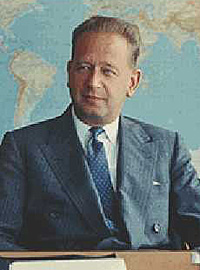
Immediately upon his election as Secretary General, the rumors of his homosexuality began to circulate. Throughout his life, Hammarskjöld remained without female attachments. He dismissed his lack of family life by explaining that his mother had suffered terrible loneliness as a result of his father's devotion to government service and he did not wish to inflict such a life on anyone else. Considering how rare a high-ranking single man was in any government at the time, such excuses seem rather flimsy.


Hammarskjöld held deep religious beliefs and held himself, and others, to impossibly high standards. His introspective book of personal reflections, Markings, reveals a man who frequently regarded himself and others with loathing and contempt. He never spared himself from the same exacting requirements of perfection that he sought in others. Speculation that he could see his sexuality only as a personal weakness, and therefore something to be sublimated and overcome, continues to be the primary interpretation of his apparently asexual existence.

In Markings, he leaves only vague hints that may be keys to his sexual feelings. He implies that he feels ostracized for being different, perhaps superior. In another passage, he describes someone who is more true to himself; Hammarskjöld simultaneously admires and abhors the person. While such thoughts may point to Hammarskjöld's tormented sexual conflicts, they could equally well refer to something else entirely.

Unless some hidden manuscript surfaces or an aging lover suddenly feels moved to revelation, it seems unlikely the world will ever know for sure the details of Hammarskjöld's sexual experience. W. H. Auden, who translated Markings, was convinced of his homosexuality; it is thought that saying so publicly during a lecture tour of Scandinavia may have cost Auden the Nobel Prize for Literature that he was widely expected to receive in the 1960s.

Enhanced by Zemanta

Tuesday, 20 March 2012

John Boswell (1947 - 1994), Historian and gay Catholic activist

b. March 20, 1947
d. December 24, 1994

John Boswell was an esteemed historian who argued that homosexuality has always existed, that it has at times enjoyed wide social acceptance, and that the Church historically allowed same-sex unions.

"It is possible to change ecclesiastical attitudes toward gay people and their sexuality because the objections to homosexuality are not biblical, they are not consistent, they are not part of Jesus' teaching; and they are not even fundamentally Christian."


John Boswell was a gifted medieval philologist who read more than fifteen ancient and modern languages. After receiving his PhD from Harvard in 1975, he joined the history faculty at Yale University. Boswell was an authority on the history of Jews, Muslims, and Christians in medieval Spain. He helped to found the Lesbian and Gay Studies Center at Yale in 1987. In 1990 he was named the A. Whitney Griswold Professor of History.
In 1980 Boswell published the book for which he is best known: Christianity, Social Tolerance, and Homosexuality: Gay People in Western Europe from the Beginning of the Christian Era to the Fourteenth Century. In this groundbreaking study, Boswell argued against "the common idea that religious belief-Christian or other-has been the cause of intolerance in regard to gay people." The book was named one of the New York Times ten best books of 1980 and received both the American Book Award and the Stonewall Book Award in 1981.
Boswell's second book on homosexuality in history was The Marriage of Likeness: Same-Sex Unions in Premodern Europe, published in 1994. In it he argues that the Christian ritual of adelphopoiia ("brother-making") is evidence that prior to the Middle Ages, the Church recognized same-sex relationships. Boswell's thesis has been embraced by proponents of same-sex unions, although it remains controversial among scholars.
John Boswell converted to Roman Catholicism as an undergraduate at the College of William and Mary, and remained a devout Catholic for the rest of his life. He was an effective teacher and popular lecturer on several topics, including his life journey as an openly gay Christian man.
Boswell died of AIDS-related illness on Christmas Eve in 1994 at age 47.
Bibliography:
Selected works by John Boswell:
Enhanced by Zemanta

Wednesday, 21 September 2011

The Sacred Band of Thebes: Gay lovers as the military ideal

From this side of the Atlantic, the long delay in doing away with DADT in the US seems odd, at best. In the UK, gay men and lesbians not only serve freely and openly in the armed services and in the police, but can be seen every year participating in London Pride, marching in uniform through the streets of London - and in other gay pride marches up and down the country. Elsewhere in Europe, LGBT participation in the military is at least as relaxed. This easy acceptance of gay soldiers is not a new idea - quite the reverse. In earlier times, and in other cultures, it was often assumed that military life and it's all-male environment would attract a high proportion of men who loved men, and so it did. Going back to classical times, it was even believed by some that gay soldiers represented a military ideal.

In Plato’s Symposium, Phaedrus proposed the creation of an army of lovers, because men behave at their best when in love, and that no army could be better than one composed of lovers:

“No man is such a craven that love cannot inspire him with a courage that makes him equal to the bravest born.”

In about 378 BCE, this literary speculation entered historical fact, putting the notion to practical testing, when Georgidas applied Phaedrus’ reasoning to the creation of the “Sacred Band of Thebes”, a company of 300 soldiers, comprising exclusively pairs of lovers. Was Phaedrus right? Was the Sacred band successful?

You betcha!.

For forty years, the company was celebrated throughout Greece for their courage and military success. When at last they were overcome, fighting to the last man against vastly superior numbers, their conqueror Philip of Macedon, said of them that no man, seeing their valour, could possibly think their love shameful. (Now, note,that this was Philip of Macedon, whose son Philip II was himself not averse to a little man on man action, and whose grandson was Alexander the Great, conqueror of the world ,as far as it was then known - and renowned for his love of Bagoas).

Looking back some centuries later, Plutarch was able to record that he most war-like societies were noted for male love, and listed some famous heroes who were also known for the men they loved: Meleager, Achilles, Aristomenes, Cimon, Epaminondas, and Ioläus (companion of Hercules, and at whose tomb same sex lovers were said to make their vows of commitment.)

In short, for the Greeks, ideals of male were so firmly rooted in their heroes, that it was seen as a sign of real manliness. After listing some of the most famous, from every category of leaders and thinkers, Crompton observes:

This is an astounding record, including most of the greatest names of ancient Greece, during the greatest period of Greek culture. For many biographers, for a man not to have had a male lover seems to have bespoken a lack of character or a deficiency of sensibility.

So, the verdict of the Greeks:

Straight men, with no male lovers – lacking in character;

Homophobia - origins in evil, despotism, and cowardice.

*******

But take heart, Americans. Even if you (officially) have no gay soldiers, every time you sing the Star-Spangled Banner, you are indirectly singing in praise of homoerotic relationships. The tune is based on a an English drinking song, “To Anacreon in heaven.” Before his poetry was lost to posterity, Anacreon was the most celebrated Greek lyric poet of male love.


References:

Boswell, John:  Same-Sex Unions in pre-modern Europe
Crompton, Louis: Homosexuality & Civilization
Enhanced by Zemanta

Friday, 8 October 2010

Gay Lovers in Church History

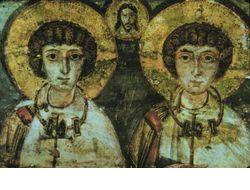
SS Sergius & Bacchus, Gay lovers, Roman soldires, martyrs and saints.
SS Sergius & Bacchus: Gay lovers, Roman soldiers, martyrs and saints.
For St Valentine's day, a partial roll call of same sex lovers (not necessarily genital, but sertainly intimate) in the history of the Catholic Church.  There are many others. These are the ones I know:
David & Johnathan
Ruth & Naomi
Jesus &  the Beloved Disciple:  We cannot know precisely the nature of this relationship, but it was clearly a close one.
Martha & Mary - Described in the New Testament as 'sisters', but this may have been a euphemism for lesbian lovers.
Philip and Bartholomew:  Included in the Apostles, frequently named in the early liturgies of same-sex union.
Peter and Paul: Primary apostles, also frequently named in the early liturgies of same-sex union.
The Roman Centurion and his "pais" (= slave/lover).
John Finch and Thomas Baines, buried together in Christ's College Chapel, Cambridge.  17th Century.
Euodia and Syntyche of Phillippi: a missionary couple active in the early church (?), mentioned in St. Paul's letter to the Philippians (4:2-3)
Tryphaena and Tryphosa: a missionary couple active in the early church (?), mentioned in in Rom 16
Perpetua and Felicitas:
Paul and Timothy:
Tychicus and Onesimus:
Zenas and Apollos:
Polyeuct and Nearchos: third-century Roman soldiers who became saints.
Faustinos and Donatos: buried together at Phillippi, in Macedonia.  4th century
Posidonia, and Pancharia: buried together at Phillippi, in Macedonia.  4th to 5th century.
Kyriakos and Nikandros: buried together at Phillippi, in Macedonia.  4th to 5th century.
Ss Sergius & Bacchus: Roman Soldiers, gay lovers,  martyrs - see picture.
Gourasios and Konstantios: buried together at Phillippi, in Macedonia.  4th to 6th century.
Euodiana and Dorothea: buried together at Phillippi, in Macedonia.  5th century.
Martyrios, presbyter, and Demetrios, lector: buried together at Edessa, in Macedonia.  5th to 6th century.
Eudoxios, presbyter, and of the sinner John, deacon: buried together at Edessa, in Macedonia.  5th to 6th century.
Droseria and Eudoxia: buried together at Edessa, in Macedonia.  5th to 6th century.
Athanasios and Chryseros: buried together at Edessa, in Macedonia.  5th to 6th century.
Alexandra and Glukeria: buried together at Phillippi, in Macedonia.  6th century
St Patrick of Ireland:  after his escape from early slavery, Patrick worked for time as a male prostitute. A recent history of Irish homosexualilty suggests that he may have taken a male lover in later life.
Dicul and Maelodran the wright:  buried together in the church at Delgany, County Wicklow.
Ultan and Dubthach: buried together in the church at Termonfechin, County Louth, near Drogheda.
John Bloxham and John Wyndham: buried together in Merton College Chapel, Oxford.  14th Century.
King Edward II and Piers Galveston:  well known as gay lovers, their relationship as 'sworn brothers' was recognised by the church.
William Neville & John Neville:  English knights, buried together in Galata, near Constantinople 14th Century
Nicholas Molyneux and John Winters: made a compact of 'sworn brotherhood, made in the church of St Martin of Harfleur. 15th century.
John Finch and Thomas Baines buried together in Christ's College Chapel, Cambridge.  17th Century.
Fulke Greville & Sir Phillip Sidney: the joint monument Greville planned for himself and Sidney in St Paul's cathedral was never built.  But the simple intention alone indicates the natrure of the relationship, as also its recognition by the church.
Cardinal John Henry Newman and Fr. Ambrose St.John: buried together, 19th C.
Enhanced by Zemanta