Amazon Kindle, UK


Showing posts with label gay soldiers. Show all posts

Friday, 15 March 2013

Gotthold Frederick Enslin

Who was the first American soldier to be discharged for being gay? No, it wasn’t a modern day marine under DADT, but Lt Frederick Gotthold Enslin, in 1778.

From Wikipedia:
Frederick Gotthold Enslin was the focus of one of three possible cases of sodomy documented in the Continental Army under General George Washington. The case began with a charge against an ensign for slander against another soldier. At Valley Forge, Pennsylvania, in February 1778, Ensign Anthony Maxwell was brought before a court-martial charged with "propogating a scandalous report prejudicial to the character of Lieutt. Enslin." The Ensign was ultimately acquitted of the charge. In March 1778, Lieut. Enslin was brought to trial before a court-martial. According to General Washington's report: "...Lieutt. Enslin of Colo. Malcolm's Regiment tried for attempting to commit Sodomy ..." Washington's secretary continues to describe the results of the trial in negative, descriptive terms: "His Excellency the Commander in Chief approves the sentence and with Abhorrence & Detestation of such Infamous Crimes orders Lieutt. Enslin to be drummed out of Camp tomorrow morning...."
The diary of Lieut. James McMichael records the sentence being carried out on 15 Mar 1778: "March 15. — I this morning proceeded to the grand parade, where I was a spectator to the drumming out of Lieut. Enslin of Col. Malcom's regiment. He was first drum'd from right to left of the parade, thence to the left wing of the army; from that to the centre, and lastly transported over the Schuylkill with orders never to be seen in Camp in the future. This shocking scene was performed by all the drums and fifes in the army— the coat of the delinquent was turned wrong side out." (McMichael, p. 217)

Wednesday, 21 September 2011

The Sacred Band of Thebes: Gay lovers as the military ideal

From this side of the Atlantic, the long delay in doing away with DADT in the US seems odd, at best. In the UK, gay men and lesbians not only serve freely and openly in the armed services and in the police, but can be seen every year participating in London Pride, marching in uniform through the streets of London - and in other gay pride marches up and down the country. Elsewhere in Europe, LGBT participation in the military is at least as relaxed. This easy acceptance of gay soldiers is not a new idea - quite the reverse. In earlier times, and in other cultures, it was often assumed that military life and it's all-male environment would attract a high proportion of men who loved men, and so it did. Going back to classical times, it was even believed by some that gay soldiers represented a military ideal.

In Plato’s Symposium, Phaedrus proposed the creation of an army of lovers, because men behave at their best when in love, and that no army could be better than one composed of lovers:

“No man is such a craven that love cannot inspire him with a courage that makes him equal to the bravest born.”

In about 378 BCE, this literary speculation entered historical fact, putting the notion to practical testing, when Georgidas applied Phaedrus’ reasoning to the creation of the “Sacred Band of Thebes”, a company of 300 soldiers, comprising exclusively pairs of lovers. Was Phaedrus right? Was the Sacred band successful?

You betcha!.

For forty years, the company was celebrated throughout Greece for their courage and military success. When at last they were overcome, fighting to the last man against vastly superior numbers, their conqueror Philip of Macedon, said of them that no man, seeing their valour, could possibly think their love shameful. (Now, note,that this was Philip of Macedon, whose son Philip II was himself not averse to a little man on man action, and whose grandson was Alexander the Great, conqueror of the world ,as far as it was then known - and renowned for his love of Bagoas).

Looking back some centuries later, Plutarch was able to record that he most war-like societies were noted for male love, and listed some famous heroes who were also known for the men they loved: Meleager, Achilles, Aristomenes, Cimon, Epaminondas, and Ioläus (companion of Hercules, and at whose tomb same sex lovers were said to make their vows of commitment.)

In short, for the Greeks, ideals of male were so firmly rooted in their heroes, that it was seen as a sign of real manliness. After listing some of the most famous, from every category of leaders and thinkers, Crompton observes:

This is an astounding record, including most of the greatest names of ancient Greece, during the greatest period of Greek culture. For many biographers, for a man not to have had a male lover seems to have bespoken a lack of character or a deficiency of sensibility.

So, the verdict of the Greeks:

Straight men, with no male lovers – lacking in character;

Homophobia - origins in evil, despotism, and cowardice.

*******

But take heart, Americans. Even if you (officially) have no gay soldiers, every time you sing the Star-Spangled Banner, you are indirectly singing in praise of homoerotic relationships. The tune is based on a an English drinking song, “To Anacreon in heaven.” Before his poetry was lost to posterity, Anacreon was the most celebrated Greek lyric poet of male love.


References:

Boswell, John:  Same-Sex Unions in pre-modern Europe
Crompton, Louis: Homosexuality & Civilization
Enhanced by Zemanta

Harmodius & Aristogiton: Gay Soldiers at the Foundation of Democracy

The idea of male love was deeply embedded in early Greek culture. Even the gods enjoyed men. Zeus, leader of the pantheon, was renowned for his capture of Ganymede; almost all the remaining make gods also had affairs with men or boys. The heroes of Greek myth ere also affected – Achilles and Patroclus were celebrated by Homer for their prowess as warriors, by later poets and dramatists as lovers.

Athenian democracy began with the overthrow of the rulers known as the “tyrants”. What I didn’t realise until I re-read it in Boswell’s “Same Sex-Unions in Pre-Modern Europe”, was that this overthrow (and hence paving the way for democracy) was credited by Plato to two lovers, Harmodius and Aristogiton.


Tuesday, 20 September 2011

Gay Soldiers? Role Models, at the Foundation of Democracy.

From this side of the Atlantic, the continued reluctance to do away with DADT seems odd, at best... In the UK, gay men and lesbians not only serve freely and openly in the armed services and in the police, but can be seen every year participating in London Pride, marching in uniform through the streets of London - and in other gay pride marches up and down the country. Elsewhere in Europe, LGBT participation in the military is at least as relaxed.
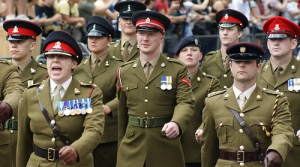


Military Pride

It’s not even as if gay soldiers were a new idea. To demonstrate, I want to pay a brief visit to ancient history – but first, I have to ask, “Why do we have a military?” Obviously, for defence – but what is it exactly, we wish to defend? For many of us, that answer is likely to include “democracy”, or even, more grandly “Western civilization”. Now, here’s the thing – a quick look at history shows that gay soldiers were there at the very start of democracy (Plato gives two gay lovers in particular the credit for its very foundation), and were conspicuous thereafter in the defence and development of both democracy and the broader notion of “civilization”. Now, granting that it is a gross oversimplification, let us begin by noting that both democracy as a form of government, and classical culture on which much of European civilization was built, began in Greece, particularly in Athens.

Harmodius & Aristogiton

The idea of male love was deeply embedded in early Greek culture. Even the gods enjoyed men. Zeus, leader of the pantheon, was renowned for his capture of Ganymede; almost all the remaining make gods also had affairs with men or boys. The heroes of Greek myth ere also affected – Achilles and Patroclus were celebrated by Homer for their prowess as warriors, by later poets and dramatists as lovers.

Athenian democracy began with the overthrow of the rulers known as the “tyrants”. What I didn’t realise until I re-read it in Boswell’s “Same Sex-Unions in Pre-Modern Europe”, was that this overthrow (and hence paving the way for democracy) was credited by Plato to two lovers, Harmodius and Aristogiton.

Athens at the time was under the control of two Tyrants, the brother Hipparchus and Hippias. Hipparchus made a pass at Harmodius, which was rejected.. After he had been rejected a second time, Hipparchus retaliated, then the two lovers got up a conspiracy to overthrow the two. In later years, their fame was such that they were the first men ever to have statues built to them in the public square of Athens, and had images of those statues imprinted on the city’s coinage. These images are said to have become ,as much identified with democracy in Athens as the Statue of Liberty is in New York. They had a popular song sung about them for centuries, recorded by Athenaeus 700 years later. Miltiades used their memory to inspire his troops before the battle of Marathon, saluting them as “Athens’ greatest heroes.” Callisthenes, described them as the men most honoured by Athenians, because they destroyed one of the tyrants and so destroyed the tyranny. Demosthenes called them

“the men to whom you have allotted by statute a share of your libations and drink-offerings in every temple…… and in worship, you treat as the equal of gods and demi-gods.”

With all this praise for the men what does this say about attitudes tot heir love? Plato clearly linked their action to their love, and had some harsh words for critics of their orientation –those whom we today would call the “homophobes”. Here’s Plato:

“Our own tyrants learnt this lesson. Through bitter experience, when the love between Aristogiton and Harmodius grew so strong that it shattered their power”.

Did you get that? Plato states clearly that the power of the tyrants was “shattered” by the strengthening love of two men. He continues with some observations on the origins of opposition to same sex love, which are pertinent to modern homophobia too:

“Wherever, therefore, it has been established that it is shameful to be involved in sexual relationships with men, this is die to evil on the part of the legislators, and to despotism on the part of the rulers, and to cowardice on the part of the governed. “

That’s right, folks. Homophobia originates in evil, despotism, and cowardice. Cowardice? But, wait, isn’t that typical of those weird queers, aren’t they the sissies? That’s not how the ancients saw it, and they had evidence on their side, evidence from the military record. The Greeks were familiar with male lovers among the heroes of with and legend, from Zeuss himself, at the head of the gods, who had abducted Ganymede to be his lover and cupbearer, through Achilles and Patroclus, celebrated by Homer for their bravery and for their love, and also Iolaus, companion of Hercules and participant in his celebrated labours, by whose tomb pairs of lovers were said to pledge their commitments to each other.

Gay lovers: the ideal warriors

Is it surprising that some people began to propose taking advantage of the courage of gay lovers in defence of the city? In Plato’s Symposium, Phaedrus proposed the creation of an army of lovers, because men behave at their best when in love, and that no army could be better than one composed of lovers:

“No man is such a craven that love cannot inspire him with a courage that makes him equal to the bravest born.”

In about 378 BCE, this literary speculation entered historical fact, putting the notion to practical testing, when Georgidas applied Phaedrus’ reasoning to the creation of the “Sacred Band of Thebes”, a company of 300 soldiers, comprising exclusively pairs of lovers. Was Phaedrus right? Was the Sacred band successful?

You betcha!.

For forty years, the company was celebrated throughout Greece for their courage and military success. When at last they were overcome, fighting to the last man against vastly superior numbers, their conqueror Philip of Macedon, said of them that no man, seeing their valour, could possibly think their love shameful. (Now, note,that this was Philip of Macedon, whose son Philip II was himself not averse to a little man on man action, and whose grandson was Alexander the Great, conqueror of the world ,as far as it was then known - and renowned for his love of Bagoas).

Looking back some centuries later, Plutarch was able to record that he most war-like societies were noted for male love, and listed some famous heroes who were also known for the men they loved: Meleager, Achilles, Aristomenes, Cimon, Epaminondas, and Ioläus (companion of Hercules, and at whose tomb same sex lovers were said to make their vows of commitment.)

In short, for the Greeks, ideals of male were so firmly rooted in their heroes, that it was seen as a sign of real manliness. After listing some of the most famous, from every category of leaders and thinkers, Crompton observes:

This is an astounding record, including most of the greatest names of ancient Greece, during the greatest period of Greek culture. For many biographers, for a man not to have had a male lover seems to have bespoken a lack of character or a deficiency of sensibility.

So, the verdict of the Greeks:

Straight men, with no male lovers – lacking in character;

Homophobia - origins in evil, despotism, and cowardice.

*******

But take heart, Americans. Even if you (officially) have no gay soldiers, every time you sing the Star-Spangled Banner, you are indirectly singing in praise of homoerotic relationships. The tune is based on a an English drinking song, “To Anacreon in heaven.” Before his poetry was lost to posterity, Anacreon was the most celebrated Greek lyric poet of male love.

This brief look covers only classical Greece - but the pattern is [repeated elsewhere, in the rest of Europe, in Lcassicl and modern times, in Asia - and prett well everywhere, in every age. More will follow.


References:

Boswell, John: Same-Sex Unions in pre-modern Europe

Crompton, Louis: Homosexuality & Civilization

Saturday, 10 September 2011

Bravehearts: LGBT Soldiers, Police, Adventurers and Explorers - from Matt & Andrej Biographies.

Queer men and women are found, and have always existed, in all walks of life - including those which appear superficially to stand in direct opposition to the standard stereotypes. The stereotypes in fact are culturally and historically specific, to distinct regions and eras. Until recently, USA publicly took the view that gay men and women were inherently unsuitable for military service - but some societies took the diametrically opposite view, that gay men were particularly good military material (in the Sacred Band of Thebes, for example, or among the Japanese Samurai).

Matt & Andrej Kowalsky "Biographies of Famous GLTB People (Or who tried it at least once...)" lists an extensive collection of short biographies, with an indication in the headline for each entry if the country of origin, dates and main occupation or claim to queer fame. The list below is a selection from the full listing of those who are described as soldiers, other armed forces, civilian navy or aviation, policemen, adventurers and explorers.


This page is limited to those who are no longer alive. For a companion listing of those who are listed as "living" (at least at the time of posting), see the entry at "It's a Queer World".


Canada

Birch, James

Markland, George Herchmer

Marshall, George
China

Chang Pao
France

Bonneval, Claude Alexandre Comte de

De Seytres, Hippolyte

Gourgaud, Gaspard

Napoleon I Bonaparte

Nevers, Louis de Gonzague Duc de
Germany

Henry, Prince of Prussia
Greece (Classical)

Alexander the Great
Italy

Gorani, Count Giuseppe
Palestine

George, Saint
Portugal

Magellan, Ferdinand
Rome

Marcus Antonius
Russia

Davydov, Vladimir (Bob)

Durova, Nadezhda

Makarov, Stepan

Nevsky, Aleksandr
Spain

Erauso, Doña Catalina de

Fernández de Córdoba, Gonzalo
UK

Esher, Viscount

Fitzgerald, Oswald

Gordon, Charles George

Hitchin, Charles

McNally, Eddie
USA

Berg, Vernon "Copy"

Bolt, Frank Lucas

Buffalo Calf Road Woman

Daly, Jo

Enslin, Lt. Gotthold Frederick

Hoover, J. Edgar

MacDonald, Sir Hector Archibald

Maclean, Donald

Matlovich, Leonard

McCosker, Edward

Noyce, Wilfred

Related Posts

Friday, 6 August 2010

Epaminondas: Military Hero, Democrat, Cultured Statesman. Gay.


Epaminondas lived before the Christian era, outside the Jewish tradition, and has no claim whatsoever to be treated as a “saints in any literal sense. However, taking the term much more loosely, including those we might consider as role models, he clearly fits the bill. If that doesn’t suit you, think of him as included in the “others” of my title.

Together with his lover Pelopidas, Epaminondas was one of the celebrated “Sacred Band of Thebes”, a military company of 150 pairs of lovers. That’s right, an army band where it was compulsory to be gay – and partnered. We usually think of the Spartans as the most military of the Greek cities, and with good reason. While Athens (and some other cities following them) valued democracy, philosophy and intellectual life generally, young Spartans were educated for one thing only – war. After Sparta had convincingly beaten Athens and her allies in the Peloponnesian War, the victors extinguished democracy in the vanquished cities, and placed their allies in command as local despots.

In the case of Thebes, they met strong resistance from the defenders of democracy, in the form of the band of male lovers. Founded initially by Georgidas, on the principle that men never fight more bravely than when fighting to protect and support their loved ones alongside them, the founding proposition was soon confirmed. In their first engagement with the Spartan enemy, victors in the recent Peloponnesian war, the new company of Theban lovers overcame a Spartan army of two to three times their number, and were able to reinstate democracy in their city.

Epaminondaswas initially somewhat hidden in the shadow of his friend Pelopidas, who succeeded Georgidas as leader just a year after the band was founded. Together, they won many famous victories. Later, overshadowing his friend, he found the more enduring fame, and for many notable qualities beyond his illustrious military career.

After assisting in the re-establishment of democracy in Thebes, he developed a career as an orator and statesman as well as a soldier. Although he was instrumental in defeating Sparta in establishing Thebes as the dominant geek power, he refused to use this power to to subject other cities to Theban domination and pillage, so that he was known as a military liberator, not a conqueror. Many scholars have described him as Greece’s greatest warrior-statesman. Diodorus Siculus wrote that he excelled all the others in valour and military shrewdness – but also in “eloquence of speech, elevation of mind, contempt of lucre, and fairness…”.
The Romans also admired him, although less enthusiastic about his cultural achievements. Cornelius Nepos included him in his Book o Great Commanders, but found it necessary to excuse his reputation as a musician and dancer on the grounds that the Greeks had a fondness for these pursuits. He “praises without reservation Epaminondas’ intellectual and athletic prowess, and finds he meets roman standards of temperance, prudence and seriousness….. and was such a lover of truth that he never lied, even in jest.” .

He died in 362, in a battle which once again defeated the Spartans, but also ended Epaminondas’ own life.
This could be my kind of guy – accomplished, virtuous, a democrat and liberator – and good-looking. Except that he lived about two millennia too soon, he could easily be seen as a great Renaissance man. My only objection? Surely he’s just too good to be true. Yet this is the picture that comes down to us from the ancients.

And to think that men of this calibre are not permitted to serve openly in the US army.

(Source: The material above condenses a passage from “Homosexuality & Civilization” by Louis Crompton, which makes an excellent and stimulating introduction to the history of homosexuality.)

Saturday, 3 July 2010

Modern History: Out in the Forces, UK

Over the last year or so there have been many notable anniversaries of landmarks on the way to LGBT equality: 40 since since Stonewall (June last year), 40 years since the first gay liberation march (June this year); 20 years since the first civil unions in Denmark (last year),10 years for those in Vermont (June this year), 5 years for the first full marriages in Massachusetts. Here's one that passed me by - possibly because it's more difficult to pin it down to a specific date in th year, possibly because it will have been missed by the American media that so dominate our news cycle.


2010 marks ten years of openly gay and lesbian members serving in the British armed forces.

Wednesday, 10 March 2010

Gays in the Military: Japan

Now that DADT is finally under serious review, it is once again appropriate to consider how other military regimens deal or have dealt with with their queer members – or aspirant members.
As I have noted before, across the EU this is simply not a question at issue.  Gay men and lesbians serve routinely, just as any other servicemen and women. Here in the UK, every July some members routinely join the annual “London Pride” through the streets of London, either in uniform, in military squads, or as individuals in other groups of specific (non- military) interest. In South Africa, the constitution’s non-discrimination clause guarantees that sexual minorities should be able to serve on the same basis as anyone else. Last month, I was intrigued by this report from Peter Toscano, telling of a South African soldier who faced a gender identity issue by transitioning – and the military authorities provided a female officer as mentor and support to help her through the process.
In European history, gay soldiers were prominent in the Greek armies: notably in the Sacred Band of Thebes and its pairs of lovers (where only gay lovers were admitted), but also in other Greek fighting forces, where they were often crucial in creating or defending democracy.
Today, I want to discuss another renowned military culture with a strong homoerotic tradition – the Japanese shoguns and samurai.
[


Samurai and Shoguns

For centuries, love and sex between men have been recorded and celebrated at the highest levels of Japanese society, including several emperors, and have especially associated with the military establishment and with the monasteries.
Back in the 12th century, the Japanese Emperor Go- Shirakawa (1156 – 1158), who was a devout Buddhist, fell in love with Fujiwara Nobuori. Then, in 1192,a later emperor Go-Shu named Minamoto Yoritomo as his military commander – i.e. “shogun”, who came to act in the name of the emperor. Yoritomo took as a lover a young officer, Yoshino.
Many succeeding shoguns followed this example, taking as lovers apprentice warriors known as “wakashu”, giving rise to the name for this type of relationship: “wakashudo”. The name given to the younger warrior lovers in these relationships were known as “gomotsu”:
“most of those who storm the battlefield, warding off the enemy and accompanying their lords to the end, are the lords’ male sex-partners.” (p 421)
“As in ancient Greece, Japanese culture idealised shudo as a source of morality and military courage.”
“In our empire of Japan, this way flourished from the time of the great Master Kobo particularly. And in the abbeys of Kyoto and Kamakura, and in the world of the nobles and the warriors, lovers would swear perfect and eternal love …..whether their partners were noble or common, rich or poor, was absolutely of no importance.
During the Ashikaga shogunate, (1338 – 2573), 6 shoguns out of 15 are known to have had wakashu lovers. Add in the succeeding Tokugawa shoguns (1573 - 1837), “at least half” of all shoguns had male love affairs.
eg. Yoshimochi, the fourth Ashikaga shogun (1395 -1428) loved a young samurai Akamatsu Mochisada, to whom he granted three provinces, simply for homosexual favour.
Yoshinori (1429 –1441 ) was a Buddhist monk from age 10 until he became shogun at 35. He invited temple entertainers to share his bed, and planned to bestow three provinces on a young man who tad taken his fancy – but this led to his death.