Amazon Kindle, UK


Tuesday, 9 October 2012

October 9th in LGBT History


Saint's Day:

Vida Dutton Scudder  ( 1861 – 1954 ) Indian / US, American Lesbian Saint for Our Times

Born this day


Harriet Hosmer (1830 – 1908 ) US
Sculptor

Camille Saint-Saens  ( 1835 –  1921 )  French
Composer / Conductor / Musician

Simeon Solomon  ( 1840 – 1905  ) UK
Painter

Mario de Andrade  ( 1893 – 1945 )  Brazilian
Poet / Author / Historian / Critic / Photographer

Stanley Kwan  (1957 –  )  Chinese
Director / Producer

Maddie Blaustein  ( 1960 –  2008 ) US
Actress

James Dreyfus ( 1968 –  )  UK
Actor

Michael Venus  ( 1973 –  ) Canadian
Actor / Artist / Producer

Michael Causer  (1989 –  2008 )  UK
Hate Crime Victim


Died this day


Benjamin Banneker  ( 1731 –  1806) US
Mathematician

Vida Dutton Scudder  ( 1861 – 1954 ) Indian / US
Author and  American Lesbian Saint for Our Times

Aileen Wuornos   ( 1956 – 2002  )  US
Serial Killer

LeRoy Whitfield  ( 1969 –  2005 ) US
Journalist / Activist

Coccinelle  ( 1931 .–  2006 )  French
Actress / Entertainer


Sodomy in history, October 9th 

1706 — English sailor James Ball is sentenced to death for sodomy with a ship boy.
1900 — The Hawaii Supreme Court upholds a sodomy conviction secured by a non-unanimous jury verdict.
1958 — The Hawaii Supreme Court rules that people of the opposite sex can be prosecuted for sodomy as well as those of the same sex.
1967 — The U.S. Supreme Court refuses to hear a challenge to the Washington sodomy law, the first challenge based on privacy rights ever to reach it.
1990 — The Maryland Court of Appeals rules that the state’s sodomy and unnatural and perverted practices law are unconstitutional as applied to people of the opposite sex, but constitutional as applied to those of the same sex. The Court misconstrues case law history in the state to justify its ruling.
1998 — The South African Constitutional Court strikes down the country’s sodomy law under the new constitution.


Sources:

Enhanced by Zemanta

Saturday, 6 October 2012

Elizabeth Bishop (1911 - 1979), Poet

b. 8 February 1911 
d. 6 October 1979


During her lifetime, poet Elizabeth Bishop was a respected yet somewhat obscure figure in the world of American literature. Since her death in 1979, however, her reputation has grown to the point that many critics, like Larry Rohter in the New York Times, have referred to her as "one of the most important American poets" of the twentieth century. Bishop was a perfectionist who did not write prolifically, preferring instead to spend long periods of time polishing her work. She published only 101 poems during her lifetime. Her verse is marked by precise descriptions of the physical world and an air of poetic serenity, but her underlying themes include the struggle to find a sense of belonging, and the human experiences of grief and longing.
-Poetry Foundation

Janet Gaynor (1906 - 1984), Silent Film Star

b. October 6, 1906
d.  September 14, 1984


American actress, who in 1928 was the first woman to receive an Academy Award, and the only person to win the award for multiple roles: Seventh Heaven (1927), Sunrise: A Song of Two Humans (1927) and Street Angel (1928). Her career continued with the advent of sound film, and she achieved a notable success in the original version of A Star Is Born (1937).

Although married (three times), she was either bisexual or lesbian and simply closeted. One of her marriages was to the openly gay costume designer, "Adrian" Adrian Adolph Greenberg. This was an obvious marriage of convenience, responding to the homophobia of the studio system, and the publicity machine which needed to surround the stars and other film personalities with (heterosexual) romantic allure. Gaynor's marriage to Adrian has been described as "undoubtedly the most famous" of the so-called New York marriages. 

Although closeted herself, Gaynor has been romantically linked with with the openly lesbian Margaret Lindsay, and with Mary Martin.

Related Posts:

Enhanced by Zemanta

Alfred, Lord Tennyson, Poet Laureate

b. 6 August 1809
d. 6 October 1892


Tennyson's life and work present a direct challenge to the conventional thinking which places a clear dichotomy between "homo-" and "hetero-" sexuality (with a passing nod to bi-). He was noted for his undoubted attraction to women, and is not known to have had any physical relationships with men, so would not normally be described even as bisexual. Yet, his celebrated verse abounds in homoerotic and androgynous imagery, his long poem "In Memoriam", written upon the death of his close friend Arthur Hallam, has been described as "the most beautiful homoerotic elegy in the English language" (Donald Hall, glbtq encyclopedia)
The poem In Memoriam about a man’s love for another man includes sexual imagery; for example, the poet compares his sorrow to the sorrow of a loving widower who misses his late wife in bed.
Tears of the widower, when he sees A late-lost form that sleep reveals, And moves his doubtful arms, and feels Her place is empty, fall like these;This is not a unique example and material that can be interpreted as homoerotic is widespread in Tennyson’s work. There has been speculation that Tennyson may have experienced homosexual feelings for his friend, though there is no question that he was strongly attracted to women. If Tennyson had bisexual feelings there is no firm evidence that he acted on them.

Tuesday, 2 October 2012

François-Timoléon de Choisy, Cross-Dressing Abbé and Priest

b. 2 October 1644
d. 2 October 1724


Born in Paris, among the notable Frenchmen of the seventeenth century, the Abbé de Choisy, also known as François Timoléon, has left for posterity a vivid firsthand description of a strong cross-gender wish. During his infancy and early youth, his mother had attired him completely as a girl. At eighteen this practice continued and his waist was then "encircled with tight-fitting corsets which made his loins, hips, and bust more prominent." As an adult, for five months he played comedy as a girl and reported: "Everybody was deceived; I had [male] lovers to whom I granted small favors."

In 1676, attended Papal inaugural bal in a female attire. In 1687, he was received in the Académie de France. In 1696 he became the Ambassador of Louis XIV to Siam. Regarding his gender identity he wrote, I thought myself really and truly a woman. I have tried to find out how such a strange pleasure came to me, and I take it to be in this way. It is an attribute of God to be loved and adored, and man - so far as his weak nature will permit - has the same ambition, and it is beauty which creates love, and beauty is generally woman's portion ... . I have heard someone near me whisper, "There is a pretty woman," I have felt a pleasure so great that it is beyond all comparison. Ambition, riches, even love cannot equal it ...


Enhanced by Zemanta

Monday, 1 October 2012

October 1st in LGBT History

Events in LGBT History: 


1989 Denmark becomes the first country to legalize same-sex partnerships, the start of the worldwide move to marriage equality. 
1994 – LGBT History Month launched in the USA

1998 – David Atlanta magazine first published (USA)
2009 – Original Plumbing (magazine by and for transmen) first published (in the US?)

2009 – Nevada, USA legalises domestic partnerships from this date


Born this day

William Thomas Beckford ( 1760 – 1844 ) UK
Author / Art Critic / Politician

George Cecil Ives  ( 1867 –  1950 ) German / UK
Poet / Author / Activist

Vladimir Horowitz ( 1903 –   1989)  Russian
Pianist

Laurence Harvey  ( 1928 – 1973) Lithuanian / UK / South African
Actor

Sylvano Bussotti  ( 1931 –  ) Italian
Composer

Klaus Wowereit  ( 1953 – ) German
Politician

Martin Andreasson  ( 1970 –  ) Swedish
Politician

Isis King  ( 1985 –  ) US
Model / Reality TV [America’s Next Top Model]

Died this day


Kurt Hiller  ( 1885 –  1972 )  German
Author / Journalist

Dorothy Arzner  ( 1897 – 1979 )  US
Director

Kenny Greene  ( 1969 – 2001  )  US
Singer / Songwriter / Record Producer

Ned Sherrin  ( 1931 –  2007)  UK
Presenter / Author / Director

Robert Arthur  ( 1925 – 2008 )  US
Actor


Died on Unknown Dates in October: 


Bernard Natan (1886 – 1942 ) Romanian / French
Director / Actor / Concentration Camp Victim

Tessa Boffin  (1962 – 1993 ) UK Photographer

Sodomy in history,  October 1st

1783 — The last execution for sodomy in France occurs—a friar is broken on the wheel.
1864 — Arkansas revises its sodomy law to mandate the death penalty for all persons.
1945 — The Colorado Supreme Court overturns a sodomy conviction. Two sailors were accused of robbing the man tried for sodomy with them, but were acquitted. Their robbery trial was mentioned in the other trial, and this was considered prejudicial.
1956 — The Second Circuit Court of Appeals upholds the deportation of a Gay alien for exposing himself in a restroom. The concurring opinion of Judge Jerome Frank limits his support for the deportation to the alien’s lying about a previous conviction. Frank embarks on a remarkable opinion raising questions about why homosexuality seems to bother people so much.
New laws take effect repealing consensual sodomy laws in Connecticut (1971) and Indiana (1977).
1973 — The Maine Supreme Court overturns a sodomy conviction because the penis had been touched, but not swallowed.
1981 — Under intense pressure from Moral Majority and other right-wing groups, the U.S. House of Representatives vetoes the new sex offenses law passed by the District of Columbia council, which includes repeal of the sodomy law. This is the first time that a District law that does not violate federal supremacy is vetoed.
1985 — An Indiana appellate court rules that an enclosed booth in a video arcade is a "public place" for purposes of sex.


Sources:

Tuesday, 18 September 2012

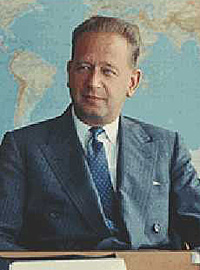
Hammarskjöld, Dag (1905-1961)

b. 29 July 1905
d. 18 September 1961

Immediately upon his election as Secretary General, the rumors of his homosexuality began to circulate. Throughout his life, Hammarskjöld remained without female attachments. He dismissed his lack of family life by explaining that his mother had suffered terrible loneliness as a result of his father's devotion to government service and he did not wish to inflict such a life on anyone else. Considering how rare a high-ranking single man was in any government at the time, such excuses seem rather flimsy.


Hammarskjöld held deep religious beliefs and held himself, and others, to impossibly high standards. His introspective book of personal reflections, Markings, reveals a man who frequently regarded himself and others with loathing and contempt. He never spared himself from the same exacting requirements of perfection that he sought in others. Speculation that he could see his sexuality only as a personal weakness, and therefore something to be sublimated and overcome, continues to be the primary interpretation of his apparently asexual existence.

In Markings, he leaves only vague hints that may be keys to his sexual feelings. He implies that he feels ostracized for being different, perhaps superior. In another passage, he describes someone who is more true to himself; Hammarskjöld simultaneously admires and abhors the person. While such thoughts may point to Hammarskjöld's tormented sexual conflicts, they could equally well refer to something else entirely.

Unless some hidden manuscript surfaces or an aging lover suddenly feels moved to revelation, it seems unlikely the world will ever know for sure the details of Hammarskjöld's sexual experience. W. H. Auden, who translated Markings, was convinced of his homosexuality; it is thought that saying so publicly during a lecture tour of Scandinavia may have cost Auden the Nobel Prize for Literature that he was widely expected to receive in the 1960s.

Enhanced by Zemanta