Amazon Kindle, UK


Sunday, 16 October 2011

Oscar Wilde, (1854 - 1900): Playwright and gay icon

b. October 16, 1854
d. November 30, 1900
"Society exists only as a mental concept; in the real world, there are only individuals."
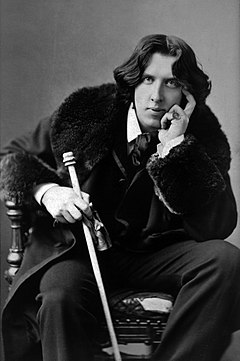
Oscar Wilde gloried in flaunting his individuality during the Victorian Era, a period synonymous with social conformity and sexual repression.

Oscar Fingal O'Flahertie Wills Wilde was born in Dublin to a mother who was a noted poet and Irish nationalist, and a father who was an eye surgeon. Wilde showed brilliance from an early age, winning prizes at school and university. At Magdalen College, Oxford Wilde adopted his signature flowing hair and flamboyant style of dress, openly scorned "manly sports," and decorated his rooms with peacock feathers and beautiful objects.

Wilde first became a public figure as a spokesman for the Aesthetic Movement, whose motto was "art for art's sake." After a lecture tour through the United States, where he met poet Walt Whitman, Wilde said that "America is the only country that went from barbarism to decadence without civilization in between."
In 1892, the debut of his first play, Lady Windermere's Fan, introduced London theatergoers to such Wildean trademark witticisms as, "My own business always bores me to death; I prefer other people's," and "I can resist anything but temptation." Wilde's plays sparkle with keenly observed satirical wit that punctures the stuffy pretenses of Victorian society.

A turning point in Wilde's life came in 1891 when Wilde, who was married and the father of two children, began an affair with Lord Alfred Douglas, known as "Bosie," son of the Marquess of Queensbury. Infuriated by his son's involvement with Wilde, the Marquess instigated legal actions that ended with Wilde's conviction on a charge of gross indecency for "a love that dare not speak its name."

In April 1895, the night he was arrested for "indecent acts," Wilde's name was removed from the playbills outside theatres in London and New York where his hit plays "The Importance Of Being Earnest" and "An Ideal Husband" were playing.

Wilde was sentenced to two years' imprisonment at hard labor. He spent the last three years of his life in poverty and self-imposed exile. He died in Paris in 1900 at the age of 46, his life undoubtedly shortened by the rigors of imprisonment

The continued popularity of Wilde's plays and his novel The Picture of Dorian Gray,as well as numerous films and books about his life, have made him an icon of popular culture. His grave in Pere Lachaise Cemetery in Paris has become a pilgrimage site.

Oscar Wilde us listed at  number 3 in Paul Russell's ranking of The Gay 100: A Ranking of the Most Influential Gay Men and Lesbians, Past and Present.

Bibliography:
Selected works by Oscar Wilde:
DVD:


Enhanced by Zemanta

Paul Monette, novelist and poet

b. October 16, 1945
d. February 10, 1995


Born in Lawrence, Massuchusetts, Monette grew up in an upper-middle-class environment; educated at the Phillips Academy, Andover, Massachusetts, and at Yale University, where he gained a BA in 1967. He subsequently taught at the Milton Academy and at Pine Manor College before settling into the life of a writer.

After moving to Los Angeles in the 1970s, Monette wrote a number of gay-themed novels, including "Taking Care of Mrs. Carrol" and "The Gold Diggers." In 1985, his world was shattered by the death of his lover of ten years, Roger Horwitz, from AIDS-related illness. Monette produced a book of poetry, "Love Alone: 18 Elegies for Rog", and "Borrowed Time: An AIDS Memoir," which became a best-seller in 1988.

Initially closeted, and after futile attempts at heterosexuality, and falling in love with a man, he finally came out. When his longtime lover Roger Horwitz was diagnosed with AIDS and suffered from a variety of AIDS-related diseases, and finally died, he became an advocate of gay and lesbian rights, and an active supporter of ACT UP (Aids Coalition to Unleash Power).

Also Monette was diagnosed with AIDS in 1991, and died four yìears later of AIDS-related complications. Nonetheless, Monette's final years were filled with love (he formed long-term relationships with casting director Stepphen Kolzak, who died in 1990 also to AIDS related illness, and then with Winston Wilde), and were amazingly productive.

Paul Monette won the 1992 National Book Award for nonfiction with his autobiographical "Becoming A Man: Half A Life Story." Written after he found out he had AIDS, it is a powerful depiction of the subjects Monette knew best: the nature of the disease, the problems of being in the closet, and the potential in gay relationships.


Source:


Gabriele Griffin, Who's Who in Lesbian and Gay and Writing, Routledge, London, 2002
Aldrich R. & Wotherspoon G., Who's Who in Contemporary Gay and Lesbian History, from WWII to Present Day, Routledge, London, 2001 - et alii

Books:

  • Taking Care of Mrs.Carroll (1978)
  • The Gold Diggers (1979)
  • The Long Shot (1981)
  • Love Alone: 18 Elegies for Rog (1987)
  • Borrowed Time: An Aids Memoir (1988)
  • Afterlife (1990)
  • Halfway Home (1991)
  • Becoming a Man - Half a Lifestory (1992)
  • Last Watch of the Night (1994)
  • Documentary about Monette:
  • Paul Monette: The Brink of Summer's End (1997)

Enhanced by Zemanta

October 16th in Queer History: Oscar Wilde, Paul Monette, and Prince Eugène of Savoy-Soisson

Born this day:


1663:  Eugène of Savoy-Soisson, royal prince and military general
1854:  Oscar Wilde, playwright, easthete and gay icon
1945:  Paul Monette, writer.
1966: Mark Gatiss;UK, Actor, Writer

Died this day:

Al-Hakem II (915 - 976), Spain
Muslim Caliph of Cordoba


Sodomy in History, October 16


1749 — North Carolina adopts the English sodomy law explicitly.
1943 — The Tennessee Supreme Court rules that fellatio is prohibited by the state’s "crime against nature" law, although the decision is neither published nor publicized.
1958 — The District of Columbia Circuit Court of Appeals overturns a conviction for sodomy after the police entered without a warrant to search the defendant’s home.


Source:
Calendar of Sodomy, October

Eugène of Savoy-Soisson, Prince and General

b. October 16, 1663
d. April 24, 1736) Italy


The son of the prince (François) Eugène Maurice of Savoy-Carignano, he was born in Paris. When Louis XIV refused him to enter in his army (1683), he entered the Austrian Army, and served against the Turks at the defence of Vienna, and against the French on the Rhine and in Italy ten years later. In 1697 he expelled the Turks from Hungary by his triumph at Zenta.

In the War of the Spanish Succession (1701-14) he shared with Marlborough in his great victories against the French (battles of Blenheim, Oudenarde, and Malplaquet), and won many successes as an indipendent commander in Italy. He again defeated the Turks in 1716-18, and fought a last campaign against the French in 1734-35. Napolen considered him as one of the seven great generals to whom the art of the war is due.

Prince Eugene of Savoy was the companion of Philippe, Duc d'Orleans the transvestite homosexual brother of Louis XIV. Eugene's sexual orientation was well known to his peers. He never married, and fellow officers referred to him as a "Mars without Venus." Eugene was particularly close to the Marquis de la Moussaye and a legend sprang up about an occurrence when they were at sea during a fierce storm. The Marquis assured the Prince that they were safe, since "We are sodomites destined to perish only by fire."
Enhanced by Zemanta

Saturday, 15 October 2011

October 15th in History : Michel Foucault, Luz María Umpierre

Born this day:


Michel Foucaultphilosopher, social theorist and historian of ideas.

Luz María Umpierre, Puerto American lesbian poet

Nigel Green (1924– 1972 ) UK 
Actor 


Sodomy in History, October 16

1749 — North Carolina adopts the English sodomy law explicitly.
1943 — The Tennessee Supreme Court rules that fellatio is prohibited by the state’s "crime against nature" law, although the decision is neither published nor publicized.
1958 — The District of Columbia Circuit Court of Appeals overturns a conviction for sodomy after the police entered without a warrant to search the defendant’s home.


Source:
Calendar of Sodomy, October
Enhanced by Zemanta

Friday, 14 October 2011

October 14th in History: Isaac Mizrahi, Leonard Bernstein, Errol Flynn(?)

Born this day:

Benjamin Sumner Welles (1892 - 1961) American
Government official and diplomat in the Foreign Service. Bisexual, he was forced to resign after he was lured into paying for sex with two African American Pullman car porters.

Isaac Mizrahi, fashion designer


Gerry Studds  (1937 – 2006)  US 
Politician  


Died this day:]

Leonard Bernstein, celebrated conductor and composer of West Side Story. A devoted husband and father, he was nevertheless undoubtedly gay, and had numerous well-documented sexual relationships and casual encounters with men, in his youth, during his marriage, and after his wife's death.

Errol Flynn, renowned ladies man - and rumoured bisexual. (Although rumours abound, he is not included on the extensive Wikipedia list of gay men and lesbians, which describes itself as "a referenced overview list of notable gay, lesbian or bisexual people, who have either been open about their sexuality or for which reliable sources exist".

Jamie Nabozny,  Youth Activist

Jamie Nabozny was the first student to successfully sue a school district for its failure to protect a student from anti-gay harassment. His 1995 lawsuit helped pioneer the Safe Schools Movement for GLBT students.

Sodomy in History, October 14


1927 — A California appellate court rules that corroborative evidence in crime against nature and oral copulation cases can be entirely circumstantial.
1941 — A newspaper reports that the Ohio Pardon and Parole Commission adopted a policy the previous year of requiring all males convicted of sex crimes to be sexually sterilized before release. The surgery performed leaves the men permanently impotent.
1986 — The U.S. Supreme Court refuses to review the decision of the Oklahoma Court of Appeals that the state’s sodomy law can not be enforced constitutionally against people of the opposite sex.
1986 — The Georgia Court of Appeals upholds a sodomy conviction even though the defendant claimed that what he was charged with doing was "anatomically impossible." The court does not detail the act.


Enhanced by Zemanta

Thursday, 13 October 2011

October 13 in Queer History,

Born this day:


Kele Okereke – Singer, Bloc Party

Alan Bray ( 1948 - 2001), UK. Historian, Activist.
Two books of importance to gay non - specialists are Homosexuality in Renaissance England, and "The Friend"

Sodomy in History, October 13

1964 — At oral argument in the U.S. Supreme Court, Chief Justice Earl Warren demands that Mississippi strike from its brief an allegation that civil rights defendant Aaron Henry had been arrested for sex with another man. Warren claims that Mississippi is "poisoning the mind of the Court and the nation."
1982 — The Maryland Court of Appeals overturns the disorderly conduct conviction of a man who said "Fuck You" to a police officer. The Court noted that the arrest was illegal unless the police officer would testify that he was sexually aroused at the thought of being fucked by another man.
2000 — The Eleventh Circuit Court of Appeals reverses a trial court and upholds an Alabama law banning sex toys.

October 14

1927 — A California appellate court rules that corroborative evidence in crime against nature and oral copulation cases can be entirely circumstantial.
1941 — A newspaper reports that the Ohio Pardon and Parole Commission adopted a policy the previous year of requiring all males convicted of sex crimes to be sexually sterilized before release. The surgery performed leaves the men permanently impotent.
1986 — The U.S. Supreme Court refuses to review the decision of the Oklahoma Court of Appeals that the state’s sodomy law can not be enforced constitutionally against people of the opposite sex.
1986 — The Georgia Court of Appeals upholds a sodomy conviction even though the defendant claimed that what he was charged with doing was "anatomically impossible." The court does not detail the act.

October 15

1918 — The Oregon Supreme Court upholds a sodomy conviction after the prosecutor made reference in the trial to the "past glories of Greece."
1963 — The Georgia Supreme Court overrules a 1917 precedent and holds that cunnilingus is not a violation of the sodomy law.
1975 — The North Carolina Court of Appeals rules that penetration is not necessary to complete an attempt to commit sodomy.
1998 — A federal judge strikes down Maryland’s "unnatural and perverted practices" law on broad privacy grounds and the state does not appeal.

October 16

1749 — North Carolina adopts the English sodomy law explicitly.
1943 — The Tennessee Supreme Court rules that fellatio is prohibited by the state’s "crime against nature" law, although the decision is neither published nor publicized.
1958 — The District of Columbia Circuit Court of Appeals overturns a conviction for sodomy after the police entered without a warrant to search the defendant’s home.